Zach Cregger's Resident Evil Is a 90 Minute Survival Horror Comedy That Feels Like Playing a Video Game
The Barbarian and Weapons director brings his signature dark humor to the franchise with an original story starring Austin Abrams as a medical courier having the worst night of his life.

Zach Cregger's Resident Evil opened in theaters today, and it's a different beast entirely from the seven previous films in the franchise. Clocking in at a shockingly brisk 90 minutes, the movie feels like running through the best carnival haunted house you've ever been to, blending Cregger's awkward humor with disgusting practical effects and a breakneck pace that never lets up.
Cregger isn't adapting any of the many Resident Evil games, and he's not recreating anything from the previous movies starring Milla Jovovich. Instead, he's grafting his own original story into the Resident Evil world, co-writing the script with Shay Hatten and bringing the same dark comedic sensibility he showed in Barbarian and Weapons.
The result is consistently funny, frequently scary, and unapologetically gross. It's also one of the most entertaining video game movies in years, even if it's lighter on substance than Cregger's previous work.
A Medical Courier's Nightmare Run Through Raccoon City
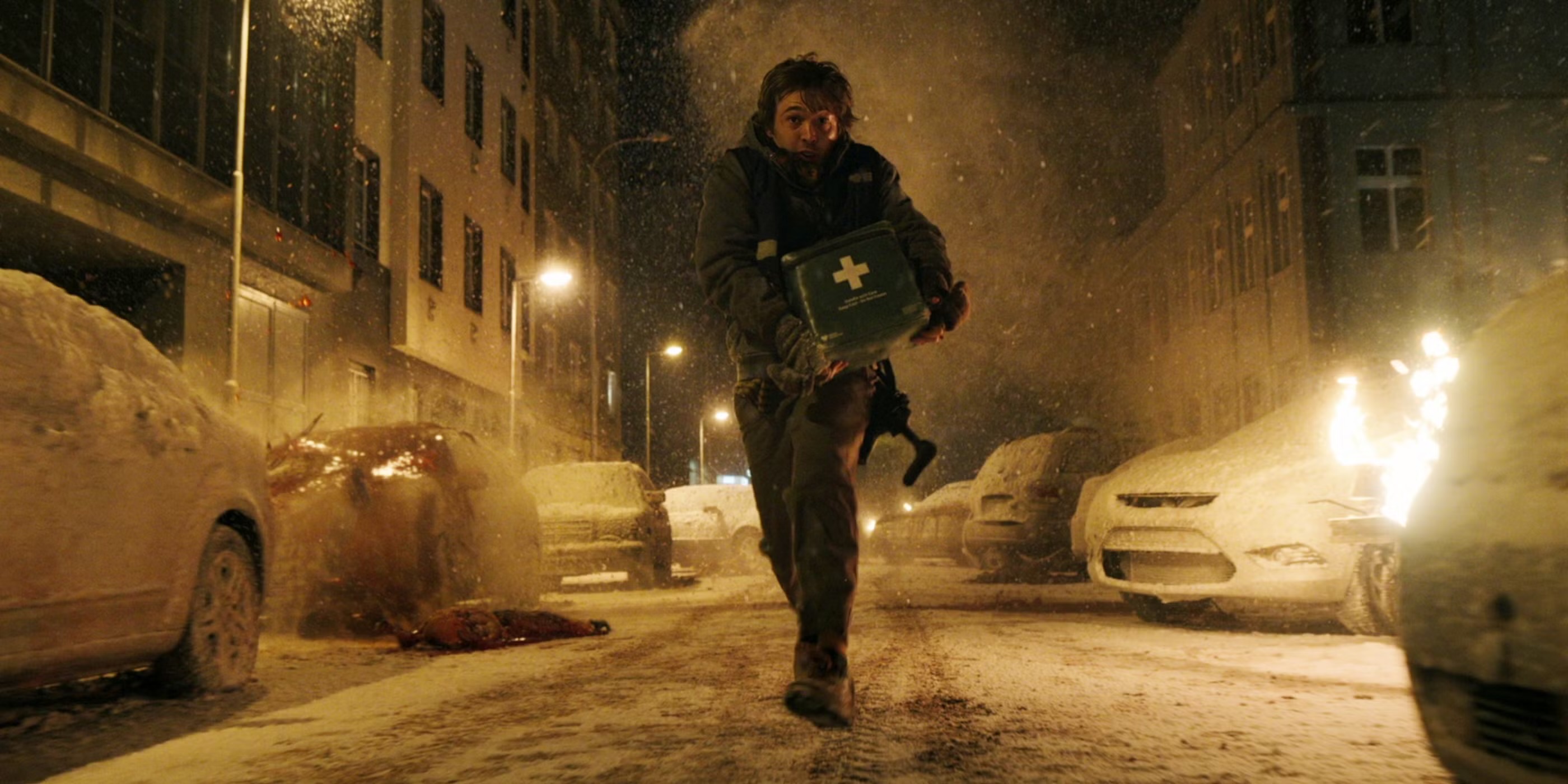
Austin Abrams, who appeared in Weapons, plays Bryan, a medical courier about to have one spectacularly bad night. His girlfriend Michelle has just revealed she's pregnant, and he's coming down off a long shift when he's offered double pay to deliver a Class A medical package to Raccoon City General Hospital.
Bryan takes the job, hoping to make some quick cash and avoid the conversation he clearly doesn't want to have. But upon entering the snowy city he hits a woman whose contorted body and semi-consciousness is more than a little odd. Things spiral from there into a wild night of zombies and mayhem that sees Bryan forced to deliver the package to the hospital in the hopes of saving humanity.
Abrams is on camera for virtually every scene of the film, making this essentially a one-man show. He's the lynchpin holding everything together, and he's laugh-out-loud funny playing the character as one of the most inept horror movie heroes of all time.

Video Game Logic Translated to Film
Resident Evil is the type of video game movie that feels like playing a video game. Cregger and Hatten lean into the limitations of a video game movie, presenting the story as a series of levels Bryan must complete. The character has an overall quest he must achieve, and along the way he reaches various locations he must defeat in order to make it to the final big bad at the end.
Bryan moves from one location to the next: a farmhouse, a tunnel choked with abandoned cars, a sewer, a city street, and so on. It has the overall feeling of a video game player moving from one level to the next, and Cregger embraces this with visual tricks that recall the feel of a game, like POV shots mixed with the camera trailing just behind Bryan.
What's fascinating is that while the audience knows this is the setup, the moves all feel organic to the nature of film itself. These don't feel like vignettes or a series of set pieces that are just plopped in. Bryan's car gets disabled sending him to an isolated farmhouse. He needs to escape the house before making it to the next obstacle he needs to defeat.
Rather than be instantly adept at everything he does, Bryan is almost always out of his element. When he picks up a gun, he doesn't really know how to use it. When he tries to ram a locked gate with a truck, it doesn't go well. There's a great running gag where he keeps trying to shoot open padlocks only to find that's not as easy as it is in movies and video games. Bryan only knows how to shoot guns from video games, and he's generally impatient and terrible at everything he attempts.
Austin Abrams Carries the Entire Film
Abrams takes the frenetic energy of his Weapons character, where he played the drug addict burglar, and focuses it down into something just as nervy but a lot more grounded and relatable. He brings a Buster Keaton level of deadpan humor to every sequence, while also possessing the comedic timing and piercing shriek of Ryan Gosling.
We're charmed by his normality. Bryan reacts like a normal human probably should when faced with tentacle monsters exploding out of places they shouldn't. He grumbles and mumbles and curses to himself as he tries to perform one annoying task after another.
Abrams spends long stretches of Resident Evil as the only human actor onscreen, and Cregger pushes him into numerous scenarios where Bryan has to narrate his way through what he's doing, often while also delivering on a comedic beat at the same time. The actor easily shoulders his promotion to leading man after his scene-stealing turn in Weapons.
A Supporting Cast That Comes and Goes
Other faces like Paul Walter Hauser and Kali Reis pop in, but they're just as quickly gone. No member of Resident Evil's supporting cast gets much more to do than drop in for a scene or two's worth of exposition. They're the trees on the side of the road that Resident Evil is racing by as it moves from beat to beat.
Reis's character Maxine is introduced as a badass enforcer for the Umbrella Corporation, the organization at the head of the Resident Evil franchise. But she's hastily dispatched with zero fanfare, more the result of lazy storytelling than anything naturally occurring in the story. After hyping up a badass it would be nice to see her actually do something for more than a second.
Hauser brings his natural ability for affability with a smarmy edge that's fun to see. His Umbrella Corporation functionary has just enough time in the spotlight to illustrate how terrible the Umbrella Corporation is. Zach Cherry is the only other actor of substance in the entire narrative and he's also a lot of fun.
But these aren't necessarily characters, just people that populate the frame to move Bryan along. No one's bad acting wise, there's just very little room for anyone in the supporting cast to be really good.
Gorgeous Cinematography and Disgusting Creatures
Cinematographer Dariusz Wolski captures Bryan's snowbound trek up the mountain in gorgeous colors, with the lights from his car contrasting the stark whiteness of all that snow. Wolski deserves extra points for finding ways to make the film, which is set entirely at night, easy to read. Every frame of Resident Evil pops.
Everywhere Bryan goes, he encounters scary, slimy mutant monsters ready to tear him apart. Something has gone terribly wrong in Raccoon City, unleashing a viral outbreak that turns humans into unspeakable creatures that feel like a cross between H.P. Lovecraft's worst nightmares and Rob Bottin's iconic creatures from John Carpenter's The Thing.
The t-Virus has a habit of rapidly mutating any human tissue it comes into contact with. There are some zombies here and there, but they're disposable. It's the more creative, nightmarish mutants which have evolved past vanilla zombie that really keep Resident Evil moving. By the time Cregger has trotted out just the film's second infected creature, it's clear that nothing breathing can be trusted not to erupt in a mess of whipping appendages and eyeballs.
These creatures feel right at home with Resident Evil's Lovecraftian design language, and they're all lovingly rendered. The film luxuriates in their oozing, thrashing, slithering glory. Many of these monsters appear to be done practically by slathering actors and puppets in a plethora of goop and goo, which is an added bonus.
The gore is ramped up to 120 percent here, with bodies and heads outright exploding. A maternity ward sequence is chock-a-block with blood, oozing pustules, and a CGI baby mutant that definitely isn't rendered perfectly. Most of the effects feel practical, and Cregger isn't opposed to making the violence utterly jarring.
The violence certainly feels disgusting, but there's an air of levity in how explosive and ridiculous, almost cartoonish, it is. A sequence of Bryan running through the empty streets as people run alongside rooftops and jump off feels like an extension of Cregger's famous Weapons run. It's hard not to have fun with a movie filled to the brim with exploding heads, mutant babies, and monsters that puke acid.
Funny When It Counts
Resident Evil is often very funny, but never in a way that feels at the franchise's expense. Cregger is broadly successful in judging how and when to lean into the campy nature of Resident Evil's pedigree for comedic effect, or to what degree Bryan's ineptitude should detour the action into a less predictable direction.
Cregger is adept at building tension in a way that makes it impossible to get a read on if that tension will pay off in a laugh or a scare. That unpredictable energy permeates Resident Evil. This dark comedic streak is a signature of Cregger's at this point, and it's a surprising and effective counterbalance to the world-shaking ramifications of the Raccoon City incident currently underway.
It's only the handful of Resident Evil's meta jokes about its video game heritage that ring a little hollow and dated. Other than that, Cregger is largely very successful at understanding how to adapt a video game into a movie in a way that serves both mediums well, even when that means subverting expectations.
A Thin Emotional Core
Bryan's moral conundrum is his decision whether he wants to have children, and throughout the night he's given numerous gory opportunities to reconcile with that, whether it's confronting a mutating little girl or a bloody maternity ward. His anxieties are serviceable enough to give structure and add some dimension to a few of the later encounters he has to survive.
There's an undercooked storyline about Bryan learning his offscreen girlfriend is pregnant and grappling with whether or not he even wants to be a father, but Resident Evil fails to explore this very much. There are even a few moments, like when Bryan has to navigate through a gruesome hospital maternity ward or when he comes face to face with an infected child, where it seems like the film is going to tie Bryan's fatherhood fears more firmly to the narrative, only to rush forward to the next gory set piece.
The movie doesn't go very far out of its way to land any of that with any real weight. Once you look beyond all the slime you start to realize there's just not a whole lot to Resident Evil. Cregger has proven he's capable of better, smarter movies than this after Barbarian and Weapons.
The film's final act also feels underdone, as if everyone ran out of ideas and decided to wrap things up quickly. Much like any video game, things get a bit downbeat once the final aims are achieved.

Breathless Fun Despite the Shortcomings
Cregger makes Resident Evil as lean as possible. There's no fat on this thing as Bryan sprints from one blood-drenched location to the next. This makes the film breathless fun, and at 95 minutes, Resident Evil is here for a good time, not a long time.
The movie hits the ground running and encounters its first zombie less than 10 minutes in. From there, Cregger doesn't ever let too long go by without putting Bryan through some funhouse maze of grotesquery he's ill-equipped to contend with, and to frequently hilarious effect.
Resident Evil is so breezy, so swift, and oh so gruesome that it's kind of hard not to throw up your hands and go along with the ride. Some of the creature designs are so delightfully twisted and strange, all writhing limbs and tumbling torsos, that you'll grin with sick glee.
Resident Evil is probably Cregger's most entertaining movie so far, even if it's lighter on depth than his previous work. It's the perfect spooky season treat, a jet-fueled horror experience that has room for lots of tension, some great laughs, and a strong central performance that makes 90 minutes fly by.
/ More from FirstDrop
 Horror News
YouTube Exec Predicts More YouTubers Will Follow Obsession and Backrooms to Oscar Contention
Pedro Pina says viral creators are defining culture and shaping the future of cinema, with more box office success st…
 Horror News
Resident Evil Targets Franchise Best Opening Weekend With $40 to $60 Million
Zach Cregger's reboot is expected to shatter the franchise's opening weekend record, with strong reviews and word of …
 Horror News
James Murray Wrote Horror Novel Don't Move, Now a New Movie in Theaters
The Impractical Jokers star turned his horror novel into a film and plans surprise theater appearances to watch it wi…
 Horror News
LA’s Largest Halloween Convention Is Here: Midsummer Scream 2026 Takes Over Long Beach
Midsummer Scream has officially returned to the Long Beach Convention Center, bringing haunted attractions, horror ve…